
Huawei has announced a major upgrade to its HarmonyOS 7 platform at the Huawei Developer Conference (HDC) 2026, introducing a new version of its Xiaoyi Smart Brain assistant and a redesigned system architecture centered on reusable “skills.”
According to Huawei executive He Gang, the upgraded Xiaoyi Smart Brain is built on an agent-oriented, self-evolving framework designed to help the operating system perform more complex tasks by combining planning, memory, tools, and execution capabilities. The announcement signals Huawei’s broader push to embed AI more deeply into the operating system rather than treating it as a standalone assistant.
The company presented the new capabilities as part of HarmonyOS 7’s system-level AI strategy, suggesting that future interactions may increasingly rely on autonomous task execution across apps, devices, and services.
Key Takeaways
- Huawei introduced an upgraded Xiaoyi Smart Brain at HDC 2026 as part of HarmonyOS 7.
- The company describes the new architecture as an agent-based, self-evolving AI framework.
- Xiaoyi Smart Brain supports planning through both cloud-based and on-device large models.
- Huawei says the system can access more than 2,100 HarmonyOS system capabilities as tools.
- The platform also incorporates over 200 types of system-level user data as memory and includes multi-device execution capabilities.
HarmonyOS 7 Moves Toward Agent-Based AI
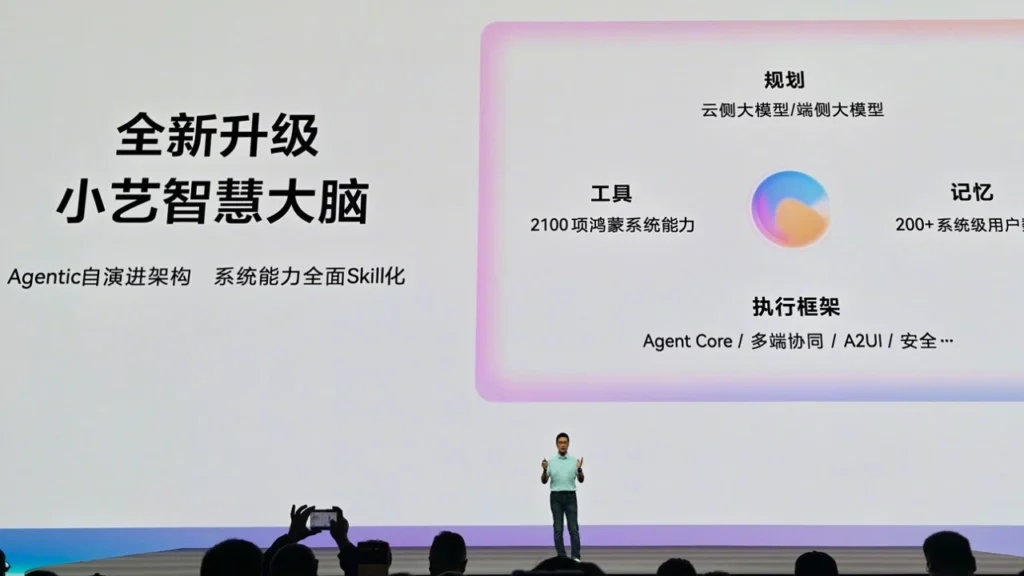
Huawei says the upgraded Xiaoyi Smart Brain is built around four core pillars: planning, tools, memory, and execution.
For planning, the system combines cloud-side and device-side large language models. This approach suggests that some AI processing can occur locally on the device while other tasks may leverage cloud resources, depending on the workload and requirements.
The tools layer reportedly provides access to 2,100 HarmonyOS system capabilities. In practical terms, this means the AI can potentially invoke a wide range of operating-system functions rather than simply generating text responses. The presentation materials shown during the announcement highlighted integrations involving web search, health-related services, scheduling functions, navigation, alarms, and coaching features.
Huawei also said the system can utilize more than 200 categories of system-level user data as memory. The company positions this memory layer as a way for the assistant to retain context and provide more personalized task execution.
Execution Framework Designed for Cross-Device Tasks
The execution component of the architecture includes what Huawei calls Agent Core, multi-device collaboration, A2UI, and security mechanisms.
While Huawei did not provide detailed technical explanations during the announcement, the inclusion of multi-device collaboration indicates that AI-driven tasks may be able to span multiple HarmonyOS devices within Huawei’s ecosystem.
The company’s presentation slides also suggest that the assistant can coordinate different services and applications to complete user requests, moving beyond simple question-and-answer interactions.
What Huawei’s Skill-Based Approach Could Mean for Users
Huawei’s emphasis on “fully skill-based” system capabilities reflects a broader industry trend toward AI agents that can perform actions rather than merely provide information.
By exposing thousands of operating-system functions as AI-accessible skills, HarmonyOS 7 could enable users to complete multi-step tasks through natural-language requests. Examples shown during the presentation included interactions involving scheduling, mapping, health services, and fitness-related planning.
The addition of planning, memory, tool access, and execution layers indicates Huawei is attempting to build a more autonomous assistant capable of coordinating actions across different parts of the operating system.
However, Huawei has not yet detailed the full scope of supported scenarios, performance characteristics, privacy controls, or rollout plans for these new capabilities.
What to Watch After the HDC 2026 Announcement
The HDC presentation provides an early look at Huawei’s direction for HarmonyOS 7, but several important details remain undisclosed.
Developers and users will likely be watching for additional information regarding:
- Availability of the upgraded Xiaoyi Smart Brain.
- Developer access to the new skill-based framework.
- Supported devices and compatibility requirements.
- Privacy and security controls surrounding the memory system.
- Real-world use cases for multi-device AI execution.
Further technical sessions and developer documentation may clarify how these capabilities will be implemented across the HarmonyOS ecosystem.
Conclusion
Huawei’s HarmonyOS 7 announcement centers on a significantly expanded AI architecture powered by the new Xiaoyi Smart Brain. By combining planning capabilities, access to thousands of system functions, contextual memory, and multi-device execution, Huawei is positioning AI as a core operating-system layer rather than a standalone assistant feature.
The announcement outlines Huawei’s vision for more capable, task-oriented AI experiences, though many implementation details and deployment specifics have yet to be disclosed.
Source: Huawei HDC 2026 presentation (as reported by ITHome At Weibo)
