
Nothing is reportedly preparing to launch the Nothing Phone 4a, with leaks and industry trends suggesting it may feature UFS 3.1 storage. This comes after the backlash the Nothing Phone 3a received for using the older UFS 2.2 storage type.
Nothing has not yet officially announced the full specifications of the Nothing Phone 4a, and the information discussed is based on current hardware trends and publicly available performance data.
Some users had expected newer storage standards, such as UFS 4.0, UFS 3.1 is still a significant upgrade over the Nothing Phone 3a’s UFS 2.2 storage.

Based on the upgraded storage configuration and current industry trends, the Nothing Phone 4a could enable smoother 4K video recording and improved camera performance.
However, Nothing has not officially confirmed these details yet. If the device ships with UFS 3.1 storage, it should offer improved gaming stability and better performance in AI-intensive workloads compared to its predecessor.
In 2026, AI features have become essential in smartphones, making daily tasks easier and more productive. While the Nothing Phone 3a comes with UFS 2.2 storage and the Snapdragon 7s Gen 3 (4 nm) processor, it may fall short of delivering a consistently premium experience in AI performance, multitasking, and long-term gaming stability when compared to newer hardware standards.
When compared with the POCO F6, which comes with the Snapdragon 8s Gen 3 (4 nm) processor and UFS 4.0 storage, the performance gap becomes more noticeable in real-world usage.
This combination brings better stability in gaming and multitasking, and thanks to the much faster read and write speeds, camera features also perform more smoothly and reliably.
Why Users Prefer UFS 3.1 over UFS 2.2 Storage Type (Analysis)
UFS 2.2 was launched around 2020 and is generally considered suitable for mid-range devices. It offers sequential read speeds of around 800–1,000 MB/s and sequential write speeds of 200–400 MB/s. It also powers the SLC cache, which helps boost overall app opening times, file copy speeds, camera performance, and the general smoothness of the phone.
However, by the beginning of 2025, AI has started taking over many core functionalities, which require significantly more power along with higher read and write speeds. As a result, speeds close to 1,000 MB/s are beginning to feel slow when handling these heavy AI-driven tasks.
In comparison, UFS 3.1 offers around a 140% boost in read speeds and up to a 240% boost in write speeds over UFS 2.2. It also improves SLC cache behavior, which together makes the system easier to manage under heavy workloads.
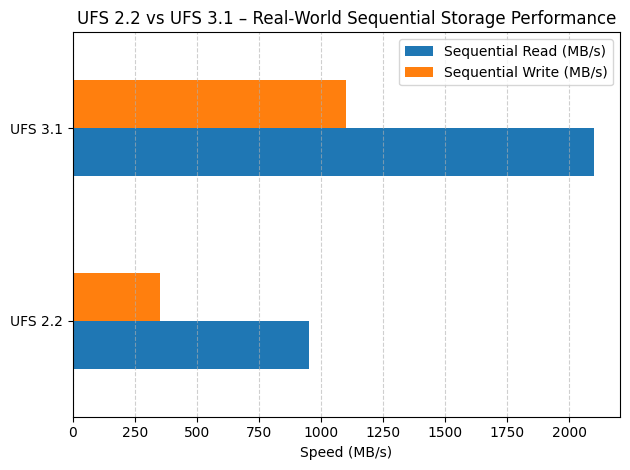
This helps handle AI-powered tasks more efficiently, improves background app performance, speeds up AI-based photo processing and system updates, and enables smoother 60 fps 4K video recording as well as 8K recording. As a result, UFS 3.1 also delivers more stable gaming performance overall.
