
Samsung’s upcoming Galaxy S26 FE has appeared on Geekbench again, this time through a Korean variant, offering another early look at the hardware expected to power the company’s next Fan Edition smartphone. While benchmark listings rarely tell the full story of a device, the latest entry reinforces a key theme: Samsung appears to be positioning the Galaxy S26 FE as an iterative refinement rather than a dramatic overhaul.
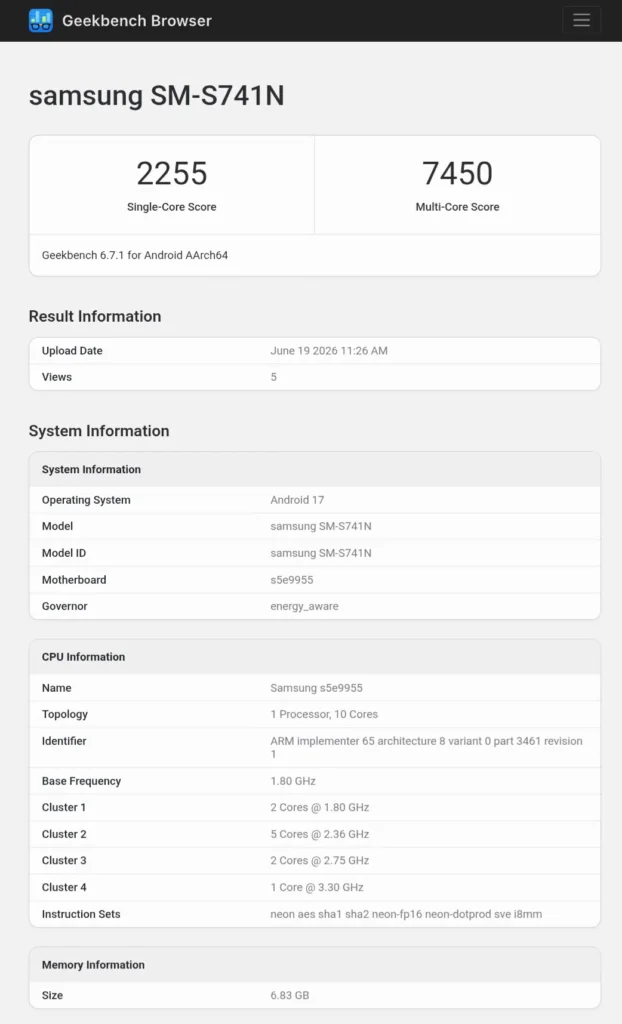
The newly spotted listing points to the use of Samsung’s Exynos 2500 chipset alongside 8GB of RAM and Android 17-based One UI 9 software. More importantly, it provides insight into how Samsung may balance performance, pricing, and product differentiation within its flagship-adjacent lineup.
Key Takeaways
- The Korean Galaxy S26 FE variant (SM-S741N) has appeared on Geekbench.
- The listing shows the device running Samsung’s Exynos 2500 processor with 8GB RAM.
- Recorded scores were 2,255 (single-core) and 7,450 (multi-core).
- The benchmark result is slightly lower than an earlier US variant listing, though such variations are common in pre-release testing.
- The phone is expected to launch later this year, reportedly during the fourth quarter.
Another Early Look at Samsung’s Next Fan Edition Phone
According to the benchmark database entry, the Galaxy S26 FE Korean model carries firmware version S741NKSU0AZFF and runs Android 17 with Samsung’s One UI 9 interface. The device achieved 2,255 points in Geekbench’s single-core test and 7,450 points in the multi-core test.
While those figures are somewhat lower than scores seen in a previous Galaxy S26 FE benchmark listing, the difference is not necessarily meaningful. Pre-release devices frequently produce varying results depending on software optimization, thermal conditions, background processes, and testing environments.
More significant than the score itself is the continued appearance of the Exynos 2500. Multiple sightings now suggest Samsung is preparing to rely on its in-house silicon for the Fan Edition model, potentially giving the company greater control over costs and supply management.
Performance May Improve, but Expectations Should Remain Realistic
Benchmark listings often attract attention because they offer a numerical glimpse of future devices. However, buyers should avoid treating early scores as a definitive measure of real-world performance.
What matters more is the reported jump from the Exynos 2400 in the Galaxy S25 FE to the newer Exynos 2500 in the upcoming model. If Samsung delivers meaningful efficiency gains alongside raw performance improvements, users could see benefits in areas such as multitasking, sustained workloads, and battery management rather than just benchmark numbers.
That would align with how Fan Edition devices are typically positioned: offering much of the flagship experience without competing directly against Samsung’s premium Galaxy S models.
Design Rumors Point to Cost and Manufacturing Considerations
Beyond performance, reports surrounding the Galaxy S26 FE suggest Samsung could bring its design closer to the standard Galaxy S26.
However, several details remain unconfirmed. Rumors indicate the camera module could be positioned higher and closer to the top-left corner than on previous models. Separately, Samsung is said to be considering a glossy rear finish instead of the matte texture used on some recent devices.
If accurate, the glossy finish could reflect broader manufacturing and cost-management decisions rather than a purely aesthetic choice. Smartphone makers across the industry continue to face pressure from component costs and supply-chain fluctuations, making material choices increasingly tied to pricing strategy.
Because these details come from reports rather than official announcements, they should be treated as preliminary.
What the Latest Benchmark Reveals About Samsung’s FE Strategy
The Galaxy FE series occupies a unique space in Samsung’s portfolio. It serves users who want flagship-inspired features without paying flagship prices.
The latest benchmark appearance suggests Samsung is continuing that formula. Rather than chasing headline-grabbing performance gains, the company appears focused on delivering a balanced upgrade cycle that combines newer hardware, updated software, and selective design changes.
For prospective buyers, that could be more important than a few hundred benchmark points. Long-term software support, everyday responsiveness, camera quality, and battery life typically have a greater impact on ownership experience than synthetic benchmark results.
What to Watch Before the Official Launch
Several important questions remain unanswered.
Samsung has not officially confirmed the Galaxy S26 FE, and details such as display specifications, camera hardware, battery capacity, pricing, and regional availability are still unknown. Future certification filings, benchmark appearances, or official teasers may provide a clearer picture in the coming months.
If Samsung follows previous Fan Edition launch patterns, additional information is likely to emerge well before an expected fourth-quarter debut.
Conclusion
The latest Geekbench appearance of the Galaxy S26 FE does not dramatically change expectations, but it does strengthen the case that Samsung is preparing another incremental upgrade for its Fan Edition lineup. The listing points to Exynos 2500 power, Android 17, and continued development ahead of launch, while early design rumors hint at possible cost-conscious hardware decisions.
For now, the benchmark offers a useful snapshot of Samsung’s direction, but the bigger story will be whether the final device delivers meaningful real-world improvements when official details arrive later this year.
Source: SammyGuru
