
Qualcomm’s next flagship mobile platform is already generating speculation, but newly surfaced block diagrams and additional leak details suggest the situation may be far simpler than some earlier reports implied. According to leaked information, Qualcomm is reportedly preparing two SM8975 variants, differentiated primarily by memory support, rather than six separate versions of the chipset.
If accurate, the approach could help smartphone makers balance rising flagship component costs while still offering premium performance tiers in 2027 devices.
Key Takeaways
- Leaked SM8975 block diagrams show two modem configurations: one with mmWave support and another focused on sub-6 GHz connectivity.
- According to the source, Qualcomm is developing only two launch variants of SM8975, not six different retail chipsets.
- The two versions are reportedly tied to LPDDR5X and LPDDR6 memory support.
- Both variants are said to use the same clock speeds, meaning memory technology may be the primary differentiator.
- The diagrams indicate multiple engineering revisions, which may have been mistaken for separate chip versions.
Engineering Samples Appear to Have Been Misread as Separate Products
One of the more important clarifications from the leak concerns the number of SM8975 variants in development.
According to the source, there are two SM8975 versions, each of which has reportedly gone through three engineering revisions. That results in six engineering samples appearing in development channels, but not six consumer-facing products.
This distinction matters because engineering samples frequently evolve throughout validation and testing. Different revisions can appear in databases, supply-chain documents, or internal references, often leading to assumptions that multiple commercial products are being prepared.
If the source is correct, buyers should not expect a fragmented Snapdragon flagship lineup with six separate SM8975 models at launch.
The Memory Split Could Become Qualcomm’s New Premium Strategy
The more interesting development is Qualcomm’s reported decision to separate the platform based on memory technology.
Leaked information suggests:
- One version supports LPDDR5X memory.
- Another supports LPDDR6 memory.
- Both versions reportedly operate at the same CPU clock speeds.
That indicates Qualcomm may be using memory bandwidth and platform capability—not CPU frequency—as the primary way to distinguish premium tiers.
For consumers, this could mean that performance differences may appear most noticeably in workloads that depend heavily on memory throughput, such as the following:
- On-device AI processing
- Large language model execution
- Computational photography
- High-end gaming
- Advanced multitasking
The practical impact will depend on how much faster LPDDR6 proves in shipping smartphones and how aggressively device manufacturers optimize for it.
What the Block Diagrams Reveal About Connectivity
The leaked diagrams show two modem implementations.
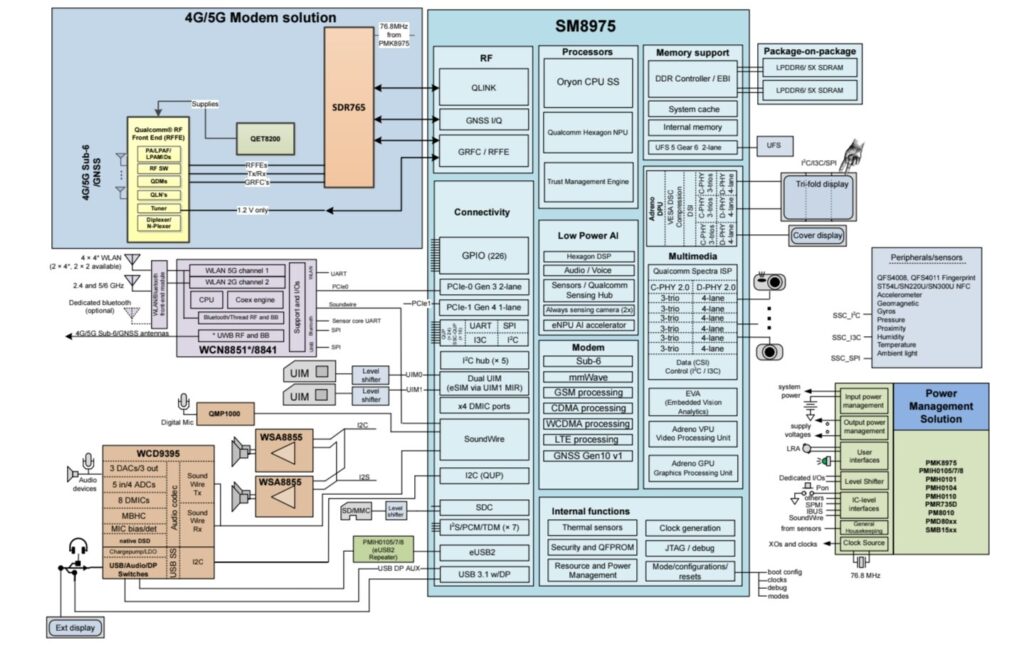
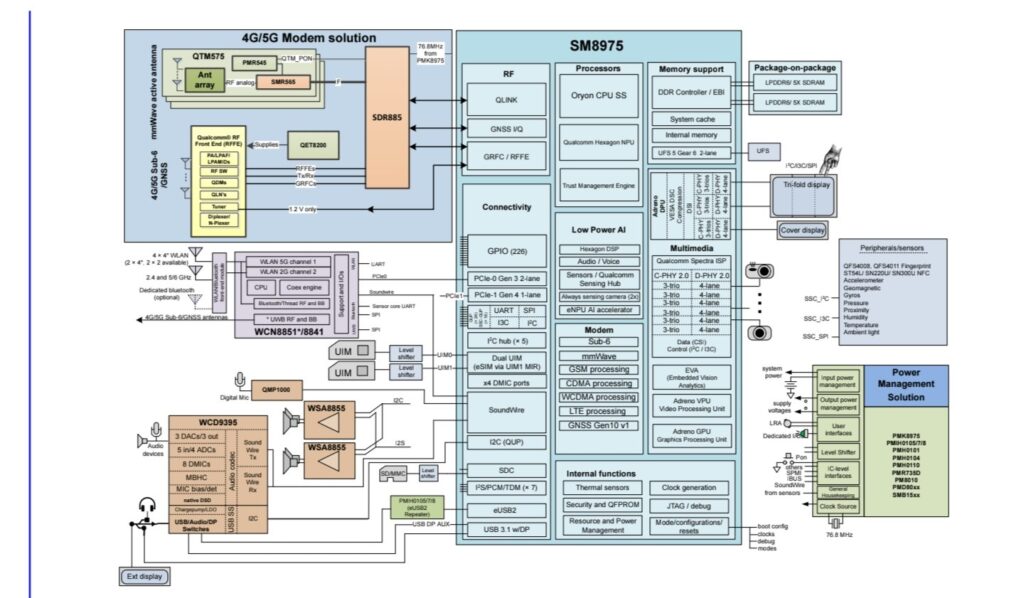
One configuration includes Qualcomm’s mmWave solution alongside Sub-6 GHz support, while the other diagram focuses on a Sub-6 GHz implementation.
For most global smartphone buyers, Sub-6 GHz remains the more important technology because it is the dominant 5G deployment method across many markets. However, mmWave remains relevant in select regions and premium devices where extremely high peak speeds are desirable.
The existence of two modem configurations does not necessarily mean two completely different flagship experiences. Instead, it may reflect Qualcomm’s efforts to support different regional requirements and device categories.
LPDDR6 Could Become a Differentiator for Ultra-Premium Phones
The reported LPDDR6-capable version appears aimed at the highest end of the Android market.
According to the source, manufacturers may be able to choose between the more affordable LPDDR5X platform and a higher-cost LPDDR6 configuration. If component pricing continues to rise, this could allow brands to create clearer separation between standard flagship models and ultra-branded devices.
For smartphone makers, that flexibility could be particularly valuable because memory costs have become an increasingly important part of flagship bill-of-material expenses.
Rather than developing entirely separate SoCs, Qualcomm could be offering different platform levels while maintaining a largely common architecture.
Several Reported Specifications Remain Unconfirmed
A number of details circulating alongside the leak should still be treated cautiously.
Reported claims include:
- A TSMC 2nm manufacturing process.
- UFS 5.0 support on the higher-end version.
- An Adreno 850 GPU in the premium model.
- Pricing that could exceed $300 per chipset.
None of those details are officially confirmed by Qualcomm at the time of writing.
While such specifications are plausible for a next-generation flagship platform, they remain part of the broader rumor cycle until Qualcomm publicly announces the product.
Final Thoughts
The most significant takeaway from the latest leak is not a dramatic performance claim or benchmark result. Instead, it is the suggestion that Qualcomm may be simplifying its flagship lineup while giving manufacturers more flexibility through memory support options.
If future leaks corroborate the information, the conversation around SM8975 may shift away from “how many versions exist” toward “which memory platform a phone uses.”
For consumers, that could make memory technology an increasingly important specification when comparing next-generation flagship devices. For manufacturers, it may offer a way to build both premium and ultra-premium phones from a largely shared platform without creating entirely separate product families.
Until Qualcomm officially unveils the chipset, however, all specifications, performance expectations, and product positioning should be considered rumored or leaked information rather than confirmed details.
Source: Reptalicant on X
