
The Redmi Note 15 has finally launched in India, powered by the Qualcomm Snapdragon 6 Gen 3 chip, built on a 4nm process. This chipset is considered an upper mid-range performer, capable of handling light gaming, multitasking, and delivering smooth overall performance.
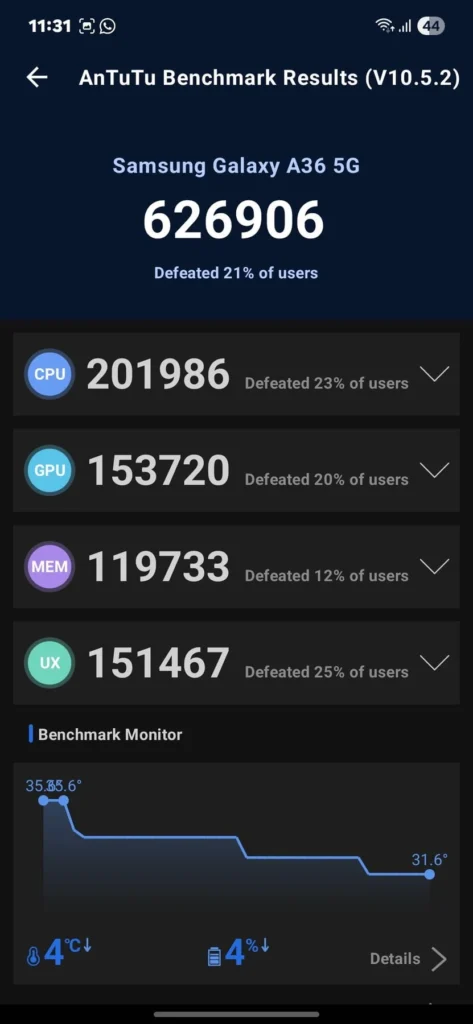
The Samsung Galaxy A36 also comes with the same chip and was launched at around Rs 30,000 (approximately $335).
In comparison, the Redmi Note 15 is expected to be priced between Rs 20,000 (around $220) and Rs 23,000 (around $255).
Performance Benchmark
The year 2026 is shaping up to be an exciting one, with many brands scheduled to launch new phones featuring major improvements in performance, cameras, battery life, and design. Today, however, we will focus on the performance benchmarks of the Qualcomm Snapdragon 6 Gen 3 chip, which powers the Redmi Note 15 5G in India.
Xiaomi has officially claimed that the Redmi Note 15 5G scores over 850,000+ on the AnTuTu V11 benchmark. In comparison, the Samsung Galaxy A36 scores around 622,000+ on V10 or V11 tests. This indicates that Redmi has properly optimized the overall functionality of the Snapdragon 6 Gen 3 chip, extracting the best possible performance from it.
The Snapdragon 6 Gen 3 chip uses an octa-core architecture with two clusters: a performance cluster and an efficiency cluster, each containing 4 cores. Typically, most mobile chips have only 1 or 2 high-performance cores in the performance cluster, with the rest placed in the efficiency cluster.
Interestingly, the Snapdragon 6 Gen 3 maximizes the number of high-performance cores in its performance cluster, using Cortex-A78 cores clocked at 2.4 GHz for demanding tasks, which allows better multitasking and overall performance.
Similarly, the efficiency cluster features 4 Cortex-A55 cores at 1.8 GHz for lighter tasks and improved battery life.
Where will it stand in 2026?
The biggest advantage of the Redmi Note 15 is its expected price range of Rs 20,000 to 23,000, which is significantly lower than the Galaxy A36, even though both phones use the Snapdragon 6 Gen 3 chip.
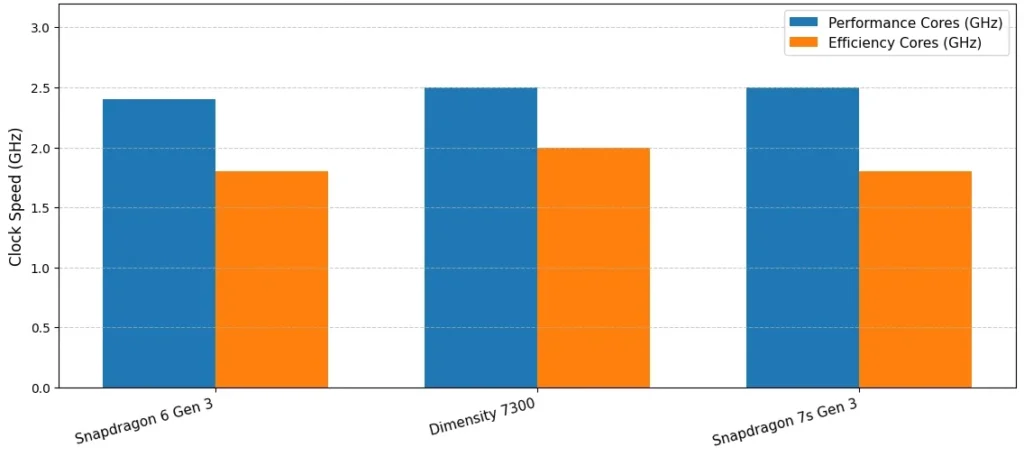
In this price segment, there are other phones that also offer strong performance. For example, the iQOO Z9s with the MediaTek Dimensity 7300 SoC and the Motorola Edge 50 Fusion with the Snapdragon 7s Gen 3 SoC are solid performers.
While the Redmi Note 15 may achieve a higher AnTuTu benchmark score due to a combination of GPU, RAM, storage, and software optimizations, the Snapdragon 7s Gen 3 still offers superior real-world CPU performance thanks to its newer Cortex-A720 cores and efficient architecture.
| Chipset | Performance Cores | Efficiency Cores | Notes |
|---|---|---|---|
| Snapdragon 6 Gen 3 | 4× Cortex-A78 @2.4 GHz | 4× Cortex-A55 @1.8 GHz | Mid-range ARM cores, balanced performance and battery efficiency |
| Dimensity 7300 | 4× Cortex-A78 @2.5 GHz | 4× Cortex-A55 @2.0 GHz | Slightly higher clocks → marginally faster than Snapdragon 6 Gen 3, a bit more power consumption |
| Snapdragon 7s Gen 3 | × Cortex-A720 @2.5 GHz (Prime); 3× Cortex-A720 @2.4 GHz (Gold) |
4× Cortex-A520 @1.8 GHz (Silver) | Newer architecture → better single-core performance, more efficient efficiency cores, smoother real-world usage |
In everyday usage and gaming, the Snapdragon 7s Gen 3 will likely feel faster and smoother than the Snapdragon 6 Gen 3. If we rank them for general day-to-day use, it looks like this:
- Snapdragon 7s Gen 3: Smoothest performance, newer CPU cores, more efficient, excellent multitasking, and better battery life.
- Dimensity 7300: Good performance with slightly older cores, suitable for apps and moderate gaming, moderately efficient.
- Snapdragon 6 Gen 3: Adequate for light use, older mid-range cores, fine for casual apps, but less smooth for heavy multitasking.
In comparison, the Snapdragon 6 Gen 3 is overall good for general use and photography, but in terms of raw performance, it lags behind even some older CPUs.
Final Thoughts
The Redmi Note 15 launches with a slightly newer chip compared to its rivals, giving it an edge in smoother daily performance and software efficiency. However, it isn’t designed to compete with higher-end devices for heavy gaming or intensive multitasking.
Buy the Redmi Note 15 if:
- You want a reliable phone for general use, calling, watching movies, or light gaming.
- You prefer a phone with a curved display.
- You want a camera phone with above-average performance and a high-megapixel setup.
- You need long-lasting battery life that can get you through the day.
Avoid the Redmi Note 15 if:
- You are looking for a phone for high-end gaming.
- You want ultra-fast charging or wireless charging in this price range.
These are the overall performance benchmarks and the Redmi Note 15’s standing in 2026, compared with other rival phones expected this year.
